
One rule, for everything that comes in
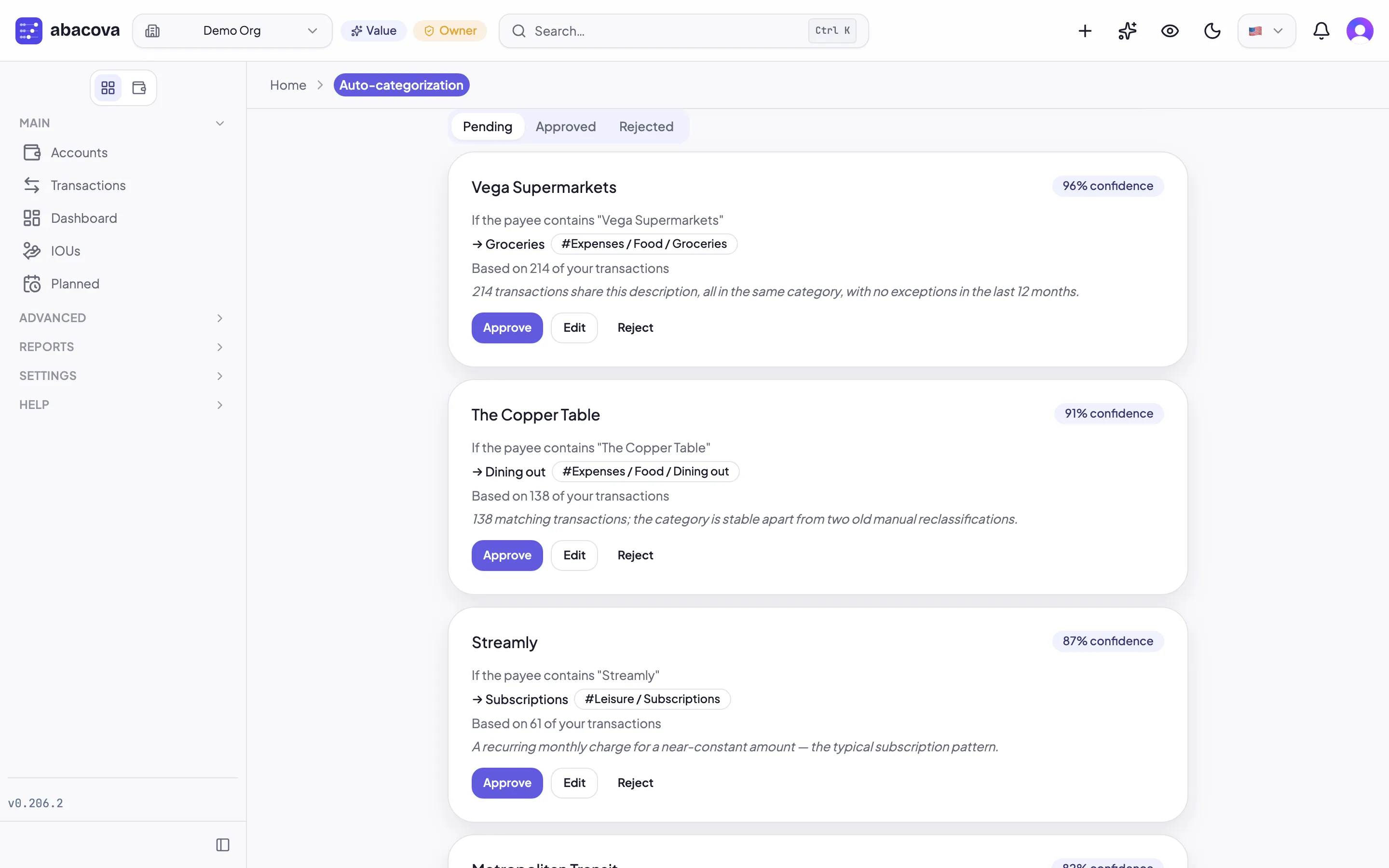
Anyone who has tracked their money for more than a month knows the moment. You open the list of transactions and there's Saturday's shop, with no category. You set it to "Groceries". On Tuesday there's another. "Groceries". The following Saturday, the same again.
None of those takes more than five seconds, and that is the problem. It's so small it never seems worth solving, so it piles up. Three months in there are forty uncategorised transactions, the month's spending breakdown no longer adds up, and keeping your accounts has started to feel like a job.
Deciding once
A rule is how you make that decision once instead of fifty times. It has two halves:
- a condition: something recognisable about the transaction, usually its description or who you paid. "The description contains Lidl."
- an action: set a category, add one or more tags, or both.
In abacova rules live in Settings. While you write the condition, the editor tells you how many of your existing transactions it matches. It sounds minor and it saves a lot of grief: if you type "Lidl" and it says 3 matches where you expected 40, you learn that your bank writes the name differently before you've saved anything.
Where it applies is the whole point
This is what separates a useful rule from a decorative one.
In abacova a transaction can arrive in four ways:
- you type it, on the computer or the phone;
- you import it from a file your bank gives you;
- you scan it from a receipt or an invoice;
- you dictate it: "paid forty at the supermarket".
Rules run on all four. There's no separate rule system for imports and another for what you type, and no path that quietly skips them. If Saturday's shop comes in with a bank file one week and you type it yourself the next, both end up in Groceries.
When a rule acts on something you're entering, you can see it. Open More options in the form and the category is already filled in, with a note that a rule applied it. Nothing hidden: just a decision you made earlier, being carried out.
Two limits, both on purpose
A rule that rewrote everything without asking would be worse than no rules at all. So there are two deliberate limits.
A rule only fills in what's empty. If you chose a category for a transaction, no rule will change it. The supermarket shop that was really for a birthday dinner, which you filed under "Celebrations", stays where you put it.
Saving a rule doesn't touch what's already there. A new rule applies to what comes in from now on. For what you'd already recorded there's a separate button, Run rules, on the rules screen. You press it when you choose, knowing what it will do, and because of the first limit it only fills gaps.
One place to fix things
The other advantage is less obvious. When you categorise by hand, a wrong habit is spread across hundreds of transactions. When a rule does it, the habit lives in one place.
If one day you decide Lidl shouldn't be Groceries but Household, you change the rule once and everything that arrives afterwards lands right. What was already categorised stays as it is, because a rule never overwrites a category that's set. Moving it is your decision, not a side effect.
If you don't know which rules to write
You don't need to start with twenty. Most people have a handful of merchants that come up every month: the supermarket, the petrol station, electricity, the phone, the gym. One rule each and the pending list shrinks to what's genuinely new.
On the plans that include it, abacova also looks at how you've categorised the same kinds of transaction in the past and proposes rules that would repeat those decisions. They are proposals: you accept or reject each one, and nothing is applied without that step. The free plan allows ten rules, which is usually enough for the regulars.
See it in a minute
This week we've cut one minute from lesson 3 of abacova's training course, Transactions, categories and rules. With a rule already in place, a supermarket shop is recorded and its category appears on its own.
The full lesson, including writing the rule step by step, is in abacova's training section. It's free.