 abacova
 A budget is an intention with a date on it and a number beside it
Nearly everyone has made a budget at some point. It usually lasts until the second week.
The easy explanation is a lack of discipline. The real explanation, most of the time, is that the thing being made was not a budget. It was an intention written down somewhere, with nothing to turn it into information while the month was still going on.
A budget needs three parts. The first two are usually there. The third almost never is.
1. An amount
"Spend less on food" is not an amount. It's a direction.
The trouble with a direction is that you can neither keep nor break it: any figure at the end of the month can be read generously. A specific number — €350 — is uncomfortable precisely because it can be checked, and that discomfort is half of what makes it useful.
2. A period
An amount with no dates means nothing. Four hundred euros on food is enormous for a week and almost nothing for a quarter. The period is what makes the number interpretable.
It is also what makes it comparable with itself. A monthly budget produces twelve measurements of the same kind each year. An intention with no period produces a feeling.
In abacova a budget runs monthly, quarterly, yearly, or over a date range you define. That last option exists because not all spending fits a calendar month: a trip, building work, Christmas.
3. Something to compare it against
This is the part that is almost always missing, and the only one that turns the other two into something useful.
An amount and a period on their own are a note. To be information, they need real spending sitting next to them, kept current, while the period is still open. The gap between those two situations is the gap between being able to do something and finding out afterwards.
It is also the part that is most work by hand, which is exactly why budgets get abandoned. Keeping a spreadsheet with real spending per category means retyping every transaction, and that lasts about three weeks.
How it works in abacova
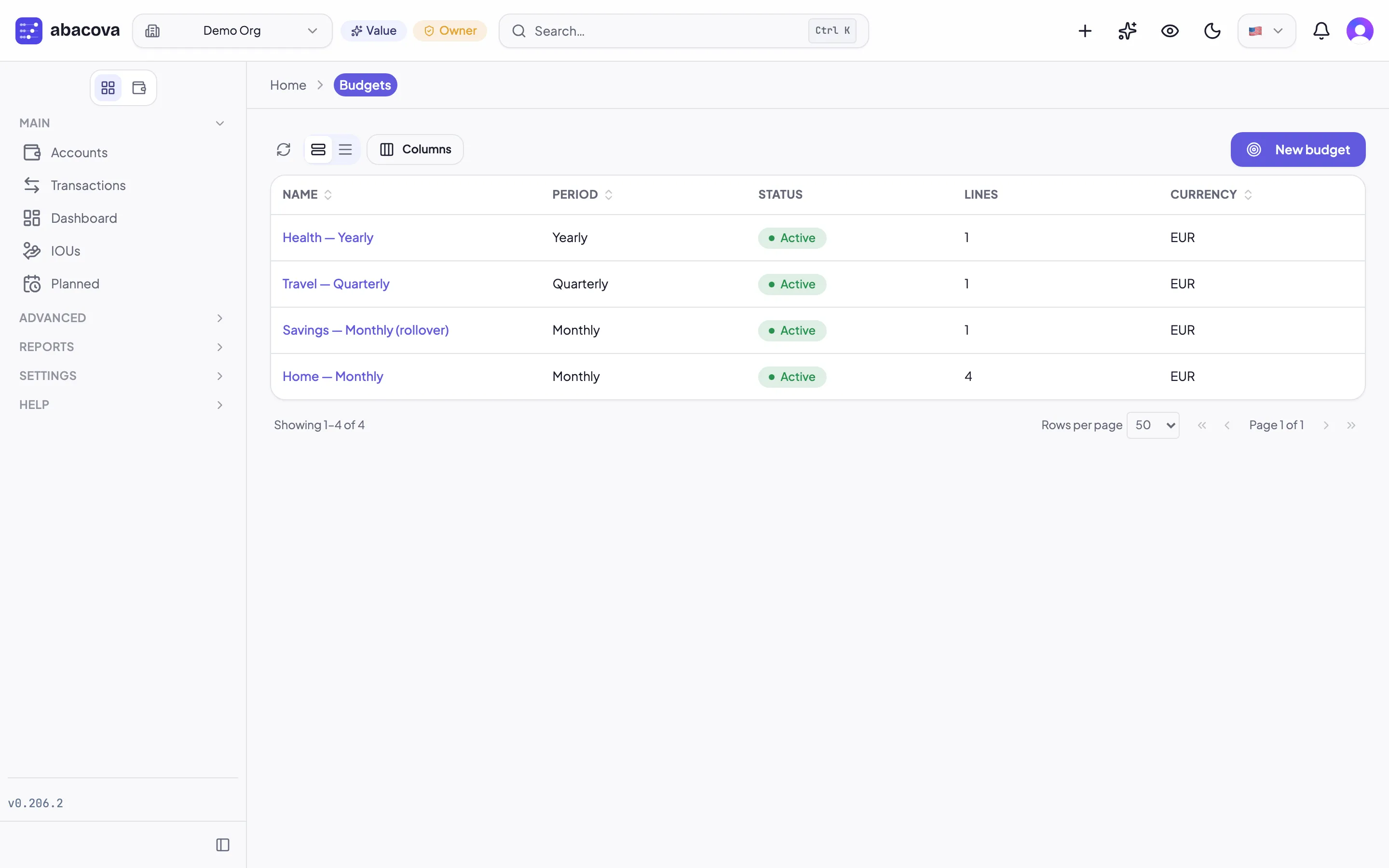
A budget assigns an amount to a scope for a period. The budgets screen shows planned and actual together, and the actual figure is worked out from your transactions: nothing is recorded twice, nothing is updated by hand, and nothing goes stale. Record a purchase today and it counts today.
That scope doesn't have to be a category. It can be:
- A category — the usual case: food, transport, leisure.
- A tag, which cuts across categories. "Trip to Rome" touches transport, restaurants and shopping, and as a budget it answers a question no category can: how much is this costing me?
- An account, when what you want to cap is what leaves one particular place.
A budget can have several lines, each with its own scope and amount, so "household spending" can be one thing made of four parts.
Alerts are what stop it becoming a post-mortem
A budget you only look at once the month has ended isn't a budget. It's a report. It arrives late by definition.
That is what overspending alerts are for: they warn you while the period is still open. They don't change anything by themselves — abacova never moves money and never blocks a payment — but they turn the budget into something that interrupts you in time, rather than something waiting for you on the 30th.
What to expect, honestly
Two things worth stating plainly.
First: budgets are not part of the free or entry plans. If you are starting out on abacova without a paid plan, you get accounts, transactions and reports, but not budgets.
Second: a budget doesn't fix anything on its own. It is a measuring instrument. What it removes is the excuse of not knowing — which turns out to be the most common excuse of all.
The short version
If you are setting up a budget this month, in abacova or in a notebook, check that it has all three parts before you start: a specific amount, a period with dates, and a way to see real spending beside it without retyping anything.
If the third is missing, what you have is a nicely worded wish. And wishes don't fail in the second week. They fail at the start — you just don't notice until the second week.