 abacova
 The four numbers worth checking once a month
Most people have an on-and-off relationship with their finances. There is a burst of enthusiasm, a fresh spreadsheet with a tab for each month, and then silence until something forces a look: an unexpected charge, a salary that runs out before the month does, a big purchase.
The problem is rarely missing data. Your bank has all of it. The problem is that looking at everything is tiring, and tiring things get dropped.
The fix isn't to look at more. It's to look at fewer things, regularly. Once a month, these four numbers answer nearly every question that matters.
1. Net worth — the direction, not the figure
Net worth is what you own minus what you owe: money in accounts, the value of investments and possessions, less mortgages, cards and loans.
The figure on its own tells you little. It depends on your age, on whether you just bought a home, on a hundred things. What tells you a lot is the direction. If net worth rises from one month to the next, even slightly, things are moving the right way. If it falls several months running, there is something to understand — even if each month looked unremarkable on its own.
That is why it pays to check it the same way, on the same day each month. One number is a snapshot. Twelve in a row are a trend.
2. Last month's net — income minus expenses
The second question is the simplest and the most avoided: last month, did more money come in than went out?
Income minus expenses. A single number, positive or negative. It doesn't explain why, but it tells you whether there is a why worth looking for.
For context, and only for context: Eurostat puts the euro-area household saving rate at 14.3% in the first quarter of 2026. That is an average across the whole economy, not a personal target, and individual circumstances vary enormously. It is still a useful reminder that a month at zero or below is not the norm.
3. Your two or three biggest categories
This is where most budgets drown: twenty categories, each with its own figure, and no conclusion.
Spending isn't spread evenly. In almost every household it clusters in a handful of places — housing, food, transport, perhaps one more. Looking only at the two or three largest is enough to see whether something has shifted, and it is where any change actually has an effect. Trimming 10% off a small category barely registers. Ten percent off the biggest one does.
The useful question isn't "how much did I spend on each thing?" It is "has one of the big ones moved since last month?"
4. Cash left after what's already committed
This is the number almost nobody works out, and probably the most important of the four.
Your account balance is misleading. If you have €2,000 today but rent leaves on the 1st, the car insurance renews the week after, and three subscriptions charge themselves, your real cushion is not €2,000. It is whatever is left once those are gone.
That cushion is what lets you absorb a surprise without reaching for a credit card, and it is not a niche concern. According to Eurostat, in 2024 30% of people in the EU said they could not cope with an unexpected expense.
Working it out is simple: available balance, minus the payments you already know will land before your next income.
How abacova handles it
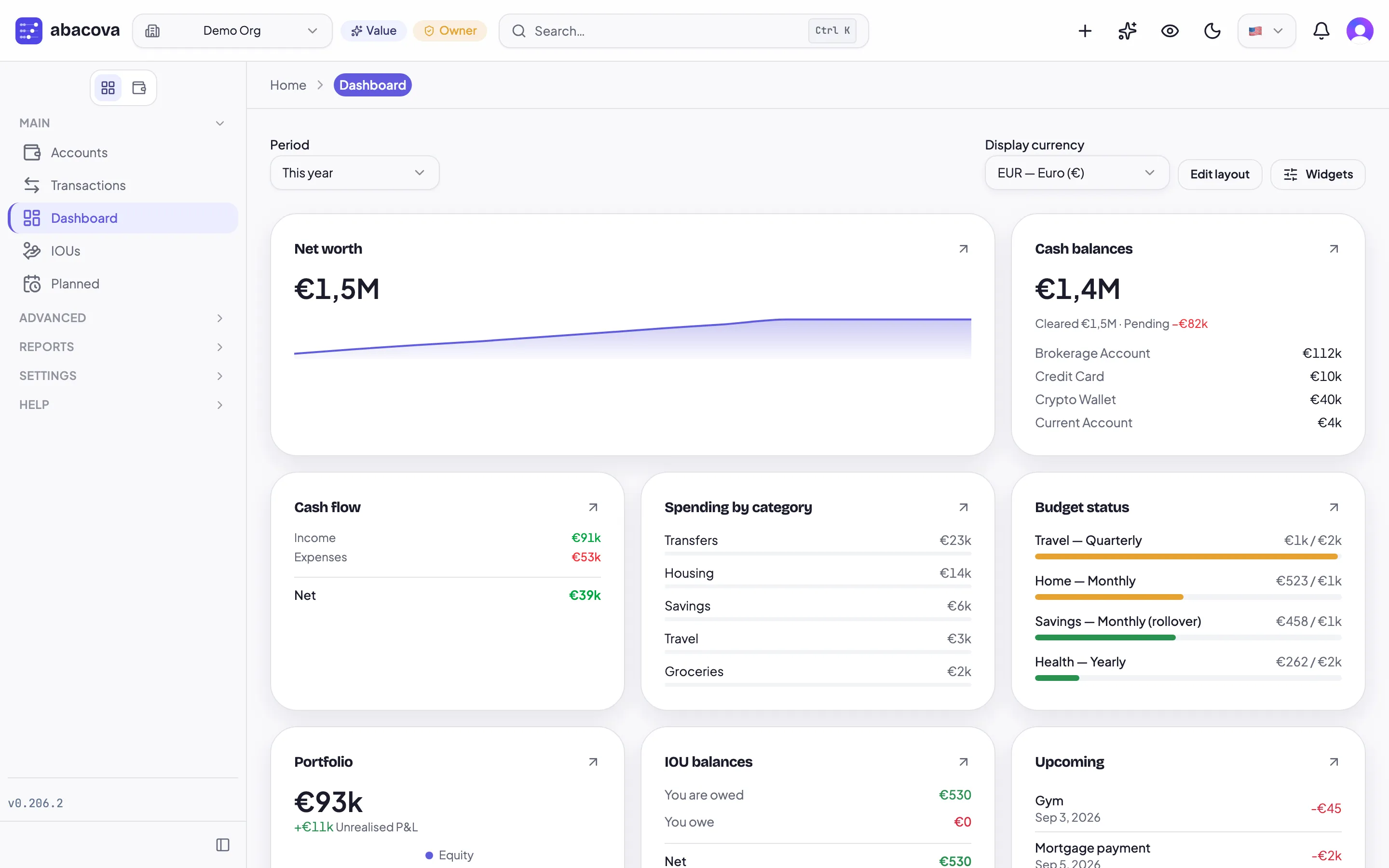
On the web, abacova's dashboard puts all four numbers on one screen:
- Net worth, in whichever display currency you choose. If a balance can't be converted, it says so rather than showing a wrong total.
- Cash flow, with income, expenses and the net for the period.
- Spending by category, so you can see where it concentrates at a glance.
- Cash balances across your accounts, and upcoming items drawn from the planned transactions you have set up — rent, salary, subscriptions.
One honest caveat: abacova doesn't detect subscriptions or recurring charges by itself. Repeating payments are set up by hand as planned transactions, once. From then on they show up in upcoming items and in the cash-flow forecast.
The dashboard has a period selector. Pick "Last month" and every widget follows. You can hide the widgets you don't use and reorder the rest, so the first thing you see is exactly what you meant to check.
Ten minutes, the same day every month
None of this takes heroic discipline. It takes a fixed slot: the first Sunday of the month, the day after payday, whatever is easiest to remember.
Four numbers, written down or just looked at, always in the same order. After a few months they stop being loose figures and start telling a story — and that story is what lets you decide calmly instead of reacting in a hurry.
The hard part was never working it out. It's looking.