 abacova
 Why abacova would rather ask than guess a category
The first time a finance app categorises an expense by itself, it looks like magic. The second time — when you discover it has quietly been filing the pharmacy under "leisure" for six months — it stops looking like magic.
That is the trouble with guessing silently. It doesn't fail visibly. It fails by accumulating.
Why a wrong category costs more than it looks
A miscategorised expense is not one isolated mistake. It is a mistake that spreads.
It spreads into that category's budget, which now says you overspent when you didn't. It spreads into the monthly report, where the breakdown describes a life you don't lead. It spreads into the comparison against last year, which is now comparing two different filing criteria rather than two years. And it spreads into whatever you decide next — which was the only part that mattered.
The worst of it is that none of those symptoms point at the cause. You see a number that looks wrong. You do not see the rule that produced it.
The alternative isn't categorising by hand forever
Giving up on automation is not the answer either. Recording everything by hand works for about three weeks and is then abandoned, which is precisely why most people do not keep track of their money.
What abacova does is separate two things that usually travel together: automating the work and deciding the criteria.
Rules do the work. A rule watches for something recognisable about a transaction — typically its description or payee — and applies a category, tags, or both. And it runs on every way a transaction can arrive: typed by hand, imported from a file, pulled from a bank feed, scanned from a receipt, or dictated. One place to fix a criterion, rather than five behaviours depending on how the expense got in.
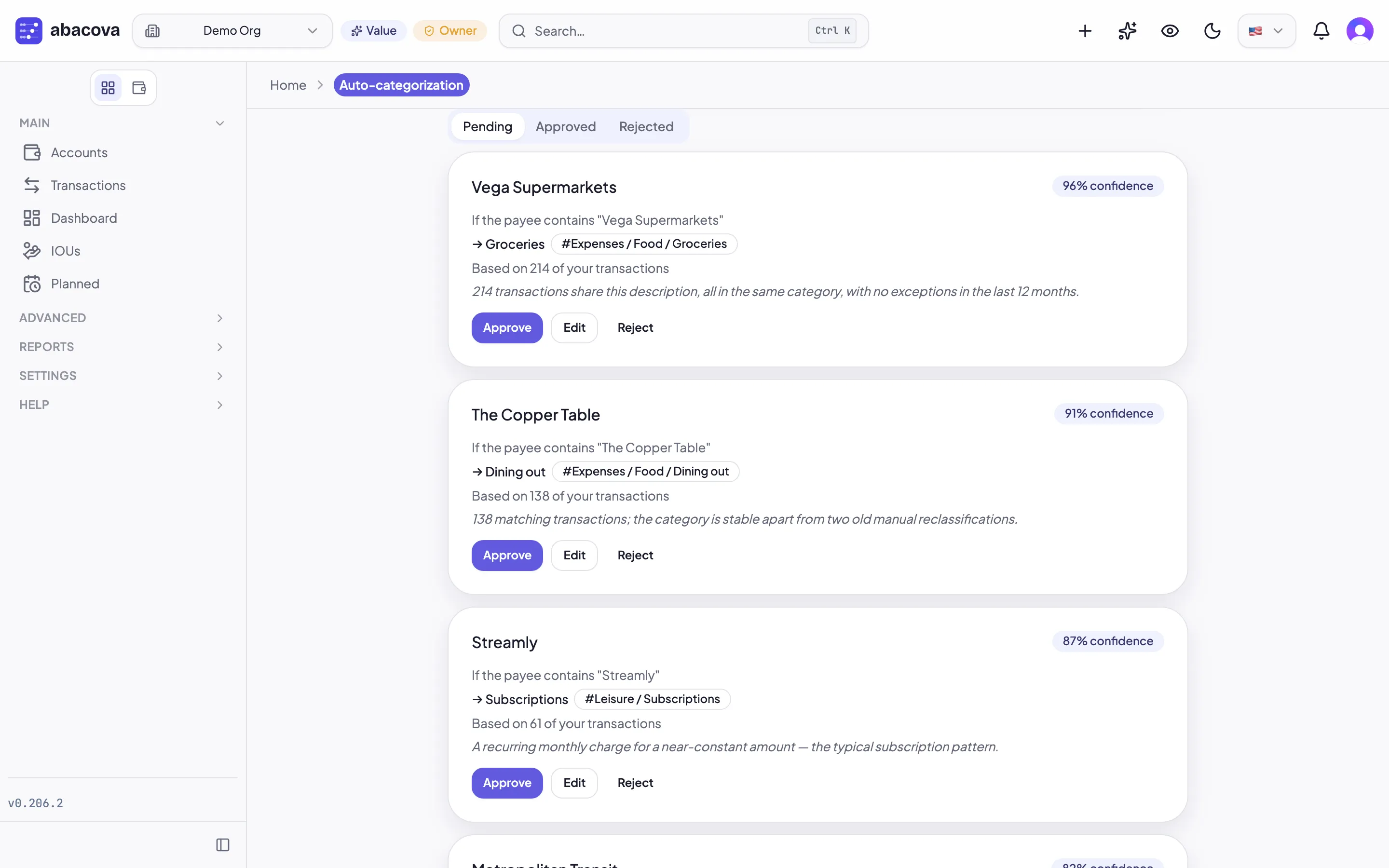
You decide the criteria. abacova looks at how you have categorised similar transactions before, and proposes rules that would reproduce those decisions. It learns from tags as much as from categories. But a proposal is reviewed and then accepted or rejected. It is not applied on its own.
Asking is cheaper than being wrong
That review step is deliberate friction, and it is worth defending, because it is easy to read as one step too many.
Accepting a proposal costs a second. Discovering three months later that a silent rule has been misfiling half your receipts costs an afternoon: you have to find it, work out what it touched, and go back and fix the transactions that already appeared in reports you already looked at.
That asymmetry is the whole reason for the design. The cost of asking is small and constant. The cost of a wrong assumption grows with how long it takes to notice — and an assumption made silently is built to take a while.
What this looks like day to day
In ordinary use almost everything is categorised for you and you never think about it. The review appears when something genuinely new does: a payee you have not seen, a pattern that resembles two categories equally well, an expense that breaks the habit.
At that point abacova would rather ask an honest question than give a confident answer. Not because it could not decide, but because your categories are yours — and an app that decides them for you ends up describing the life it assumes you lead.
One note on plans: the free plan allows ten rules, and automatic rule proposals are not part of it. Rules you create by hand work the same on any plan.